
Let’s Talk About Winchester .22-250 Remington Unprimed Rifle Brass
For those of us who take pride in hand-loading ammunition, the selection of quality brass is paramount. Winchester .22-250 Remington Unprimed Rifle Brass is a name that often comes up, a legacy brand promising consistent performance for reloaders. It’s intended for reloaders who appreciate meticulous accuracy and consistent results with their .22-250 loads.
I started hand-loading years ago to tailor my ammunition for specific hunting situations – varmint hunting in open fields demanding pinpoint accuracy at long ranges. The .22-250 Remington is a flat-shooting caliber, and I sought brass that would contribute to the round’s inherent potential.
My first impression of the Winchester .22-250 Remington Unprimed Rifle Brass was based on reputation: Winchester brass used to be the gold standard. Upon opening the box, I was immediately concerned by the varying case mouth and overall appearance. I have used Federal and Hornady brass previously, with both providing near-perfect consistency right out of the box. This Winchester brass did not compare favorably, so I was immediately concerned that this product would fail to meet my needs.
Real-World Testing: Putting Winchester .22-250 Remington Unprimed Rifle Brass to the Test
First Use Experience
I initially tested the Winchester .22-250 Remington Unprimed Rifle Brass at my home reloading bench, preparing rounds for a prairie dog hunt. After carefully weighing each case and measuring its length, inconsistencies became glaringly apparent. Some cases appeared work-hardened right out of the box.
The first attempt to prime the cases using my RCBS hand priming tool revealed a significant issue: about 50% of the cases required excessive force to seat the primer. A few cases were so tight that I feared crushing the primers. This is a critical issue, as proper primer seating is essential for consistent ignition.
Extended Use & Reliability
After loading about 30 rounds with the brass that did prime without excessive force, I took them to my local range. I was testing them in my custom Remington 700 rifle with a 26-inch barrel. I carefully recorded my groupings at 100 and 200 yards.
The results were disheartening. While the rifle is capable of sub-MOA accuracy with handloads using other brass, the Winchester brass produced inconsistent groupings, sometimes exceeding 1.5 MOA. There were several rounds with noticeably different recoil and point of impact, further suggesting inconsistency in the brass itself. After only two reloading cycles, several cases developed neck splits, a clear indication of poor brass quality and work hardening. The rounds loaded with the Federal and Hornady brass I also tested performed better.
Breaking Down the Features of Winchester .22-250 Remington Unprimed Rifle Brass
Specifications
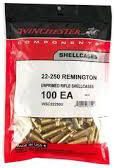
The Winchester .22-250 Remington Unprimed Rifle Brass is sold in boxes of 100 unprimed brass cases, chambered for the .22-250 Remington cartridge. The brass is made from cartridge brass, a standard alloy for reloadable ammunition. The cases are unprimed, meaning that reloaders must insert primers before loading powder and bullets.
These specifications should, in theory, provide a reliable foundation for building accurate and consistent ammunition. Unfortunately, the actual execution falls short, undermining the potential benefits of the specifications.
Performance & Functionality
The primary function of rifle brass is to contain the cartridge components and ensure proper ignition and combustion. The Winchester .22-250 Remington Unprimed Rifle Brass failed to deliver consistent performance. Primer seating issues and inconsistent case dimensions led to unreliable ignition and inconsistent velocities.
The brass did not meet my expectations. It required significantly more effort during the reloading process and produced less accurate and less consistent results.
Design & Ergonomics
The design of rifle brass is fairly standard, but the dimensions and consistency of those dimensions are critical. The Winchester brass exhibited noticeable variations in case length, neck thickness, and flash hole size.
The lack of consistency made the reloading process more difficult and time-consuming. The variations made case preparation steps like trimming and neck sizing less effective.
Durability & Maintenance
The durability of the Winchester .22-250 Remington Unprimed Rifle Brass proved to be subpar. The brass exhibited signs of work hardening after only one or two reloading cycles, leading to neck splits and case head separations.
Proper cleaning and annealing might extend the life of the brass. Considering the initial quality issues, the extra effort may not be worthwhile.
Accessories and Customization Options
The Winchester .22-250 Remington Unprimed Rifle Brass doesn’t come with accessories beyond the 100 cases in the box. Reloaders can use standard reloading dies and tools to prepare and load the brass. The cases can be neck-sized, full-length sized, and trimmed to achieve the desired dimensions.
However, due to the inconsistencies in the brass, achieving optimal results may be challenging even with high-quality reloading equipment. I use Redding Competition dies, but even they couldn’t compensate for the variances in the cases.
Pros and Cons of Winchester .22-250 Remington Unprimed Rifle Brass
Pros
- Potentially reloadable.
- Standard .22-250 Remington chambering.
- Widely available for purchase.
Cons
- Significant inconsistencies in case dimensions.
- High percentage of cases with tight primer pockets.
- Poor durability, leading to neck splits after few reload cycles.
Who Should Buy Winchester .22-250 Remington Unprimed Rifle Brass?
I struggle to recommend the Winchester .22-250 Remington Unprimed Rifle Brass to anyone seeking quality and consistency. I would not recommend this product to seasoned reloaders who demand consistent performance. I would recommend other options for varmint hunters seeking accurate and reliable ammunition.
Those new to reloading might find it frustrating and difficult to work with due to the inconsistencies. Reloaders on a very tight budget and willing to accept potentially lower quality might consider it, but even then, the potential headaches outweigh the minimal cost savings.
Conclusion on Winchester .22-250 Remington Unprimed Rifle Brass
My experience with the Winchester .22-250 Remington Unprimed Rifle Brass was disappointing. The inconsistencies in case dimensions, primer pocket tightness, and overall durability made it difficult to produce accurate and reliable ammunition.
The price of $71.99 for 100 cases might seem reasonable. The inconsistent quality and short lifespan make it a poor value compared to other brass options.
Based on my experience, I cannot recommend the Winchester .22-250 Remington Unprimed Rifle Brass. Invest in higher-quality brass from reputable manufacturers like Lapua or Nosler to achieve the accuracy and consistency you deserve. Save yourself the frustration and potential for wasted components.