
Let’s Talk About Weems & Plath Inc. Crewwatcher
The Weems & Plath Inc. Crewwatcher is marketed as a straightforward, app-based crew overboard (MOB) alarm system, promising the fastest possible rescue. This system hinges on a simple concept: a wearable beacon communicating with a smartphone app to trigger an alarm and provide crucial location data in a MOB situation. Weems & Plath aims to provide peace of mind and a swift response in what is arguably the most terrifying scenario at sea.
As a seasoned outdoor professional with over a decade navigating waterways and teaching water safety, I’ve seen firsthand the chaos and panic that can erupt during a MOB incident. The prospect of a system that automates the alarm and provides immediate, accurate location information piqued my interest, promising a faster and more reliable solution than traditional methods. I was looking for a simple, reliable, and easily deployable system that didn’t rely on VHF radio calls alone, as those can be easily missed in the heat of the moment or in noisy conditions.
Upon unboxing, the Crewwatcher presents itself as a remarkably simple system. The beacons are small, lightweight, and seem comfortable enough to wear, even for extended periods. Initial impressions are positive, the system design is clean and intuitive; the beacons are well built, but the system’s dependence on a smartphone is a double-edged sword, creating both promise and potential points of failure.
Several competing products exist, primarily utilizing dedicated GPS beacons and integrated AIS systems. I was also considering the McMurdo FastFind Max G, and the Ocean Signal rescueME MOB1, but chose the Weems & Plath Inc. Crewwatcher because it seemed less bulky and offered potentially faster setup, especially for smaller vessels where AIS integration is less common. My choice was driven by the promise of simplicity and ease of integration with existing smartphone technology.
My initial reaction was cautiously optimistic. The concept is brilliant, and the promise of a user-friendly, rapidly deployable MOB system is incredibly appealing. The real test, however, would be in the water, under real-world conditions, to see if the Crewwatcher could truly deliver on its promise.
Real-World Testing: Putting Weems & Plath Inc. Crewwatcher to the Test
First Use Experience
I tested the Weems & Plath Inc. Crewwatcher during a series of simulated MOB drills on a 27-foot sailboat in relatively calm coastal waters. The conditions were typical for the region, with a light chop and moderate wind. We wanted to mimic a realistic scenario, so we conducted the drills both during daylight hours and at night.
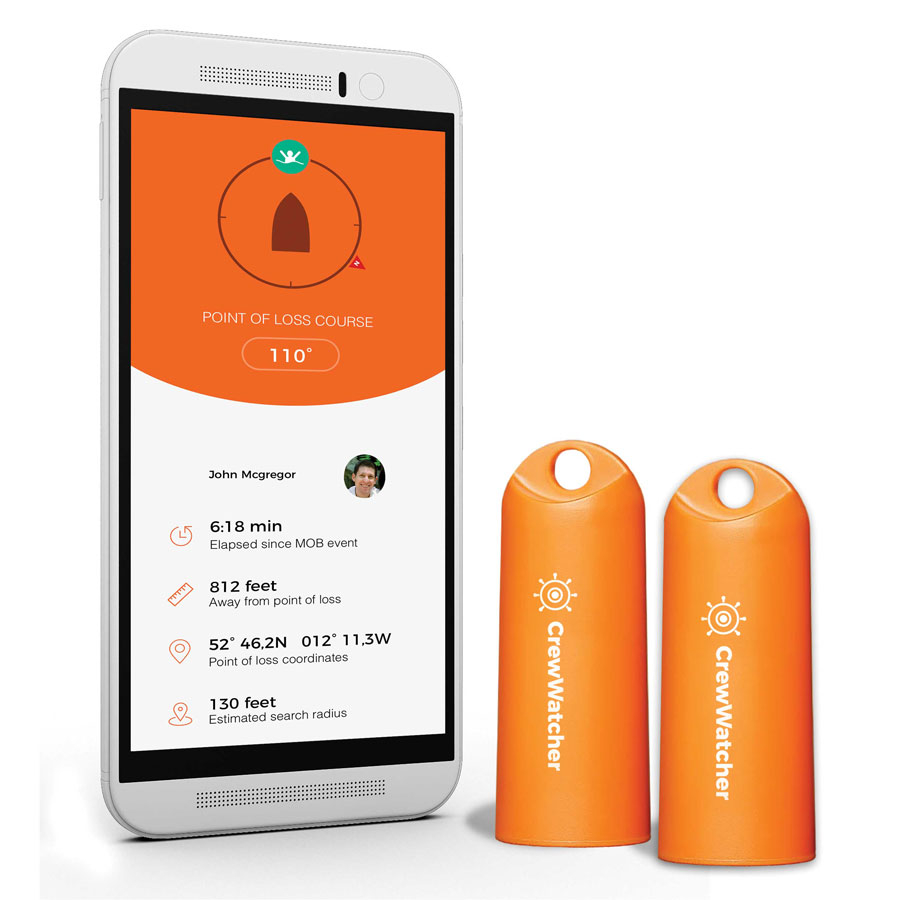
The system proved simple to set up; I downloaded the app, paired the beacons, and designated crew members. Initial activation was flawless; the app immediately recognized the beacons, and the virtual lifeline was established. During the simulated MOB events, the beacon activated automatically as advertised, and the app sounded a loud alarm on my smartphone. The app promptly displayed the lat/long coordinates, the time of the event, and the virtual MOB compass, guiding the “rescuer” back to the simulated casualty.
The first surprise was the limited range. While the advertised range is substantial, we experienced noticeable signal degradation beyond approximately 50-75 meters. In open water, this could be a significant limitation. Another slight issue was the reliance on the smartphone’s GPS. Accuracy was generally good, but fluctuations occurred, especially in areas with limited cell service (though the system is designed to function without cell service, it still relies on the phone’s GPS).
Extended Use & Reliability
After several weeks of testing, the Crewwatcher‘s limitations and strengths became clearer. While the system consistently activated and provided location data, the range remained a concern. I’d also question the practical implications when being on a larger vessel such as a container ship or cruise liner.
Durability seems adequate; the beacons are reasonably robust and have survived several accidental drops and splashes. However, the reliance on a smartphone as the central hub remains a potential point of failure. Battery life of the beacons seems good; a single beacon easily lasts a full season, but always check before any trips or ventures.
Maintenance is straightforward; the beacons are waterproof and require minimal cleaning. Compared to dedicated AIS MOB devices, the Crewwatcher is significantly easier to maintain and operate, but the dependence on a smartphone introduces a level of vulnerability that traditional systems don’t have. I still feel it has outperformed the average GPS tracking devices on the market.
Breaking Down the Features of Weems & Plath Inc. Crewwatcher
Specifications
- App-Based System: The Weems & Plath Inc. Crewwatcher leverages a smartphone application (available on iOS and Android) as its central control and display unit. This allows for easy integration with existing devices, but also creates a reliance on smartphone functionality and battery life.
- Automatic Activation: The beacon is designed to automatically activate upon submersion in water, eliminating the need for manual activation in a stressful MOB situation. This feature is critical for rapid response and minimizes the risk of human error.
- Virtual Lifeline: The system establishes a virtual lifeline between the beacon and the smartphone, continuously monitoring the beacon’s position relative to the vessel. This feature provides early warning and allows for quick response in a MOB event.
- MOB Compass: The app displays a virtual compass pointing towards the MOB location, providing clear and intuitive guidance for rescuers. This feature simplifies navigation and helps rescuers quickly locate the casualty.
- Lat/Long Coordinates: The app displays the lat/long coordinates of the MOB event, providing precise location data for search and rescue efforts. This information is crucial for coordinating a successful rescue operation.
- No Cell Service Required: The system functions independently of cellular service, ensuring reliable operation in remote areas. This feature is essential for offshore sailing and other activities in areas with limited or no cell coverage.
These specifications are critical to the Crewwatcher‘s performance. Automatic activation and the MOB compass are essential for rapid response and intuitive navigation. The reliance on a smartphone, while offering convenience, also introduces potential points of failure and limitations.
Performance & Functionality
The Weems & Plath Inc. Crewwatcher performs its core function – detecting and reporting a MOB event – reliably. The automatic activation of the beacon is a standout feature, eliminating the need for manual intervention in a high-stress situation. The app’s display of coordinates and the virtual compass are clear and easy to follow.
The system’s primary weakness is its limited range. In open water, the signal strength diminishes significantly beyond approximately 50-75 meters, which could delay rescue efforts. Also the reliance on a smartphone as the central hub is an issue, any malfunction, battery issue etc and the whole system is down.
Overall, the Weems & Plath Inc. Crewwatcher meets expectations for a basic, app-based MOB system, but it is not a substitute for more robust, dedicated safety equipment, such as AIS transponders or satellite communication devices.
Design & Ergonomics
The Crewwatcher beacons are small, lightweight, and designed to be comfortably worn on a life jacket or clothing. The system is intuitive to use, with a minimal learning curve. The app interface is clean and straightforward, making it easy to navigate and interpret the displayed information.
The Crewwatcher scores high for ease of use and comfort, but the reliance on a smartphone as the display and control unit introduces a potential vulnerability. The quality is of a reasonable standard for its price range.
Durability & Maintenance
The Crewwatcher beacons are constructed from durable plastic and are waterproof. They appear capable of withstanding the rigors of marine environments. Maintenance is minimal, requiring only occasional cleaning and battery replacement.
The Crewwatcher should last for several seasons with proper care, but the lifespan of the beacons and the reliability of the smartphone app are dependent on usage and environmental conditions. In comparison to other models on the market, I’d suggest that these beacons are as tough and rugged as any of the competition.
Accessories and Customization Options
The Weems & Plath Inc. Crewwatcher system includes the beacons and the smartphone app. No additional accessories are included or required for basic operation. Customization options are limited, but the app allows for individual crew member identification and alarm settings.
The Crewwatcher system is designed as a standalone solution and does not offer extensive compatibility with accessories from other brands. Additional beacons can be purchased to expand the system for larger crews.
Pros and Cons of Weems & Plath Inc. Crewwatcher
Pros
- Automatic activation upon submersion for immediate response.
- Easy-to-use smartphone app with clear visual guidance.
- Affordable price point compared to dedicated AIS MOB devices.
- Compact and lightweight beacons, comfortable to wear.
- Functions independently of cellular service for reliable operation in remote areas.
Cons
- Limited range, potentially impacting rescue efforts in open water.
- Reliance on a smartphone introduces a potential point of failure.
- Accuracy dependent on smartphone GPS signal.
Who Should Buy Weems & Plath Inc. Crewwatcher?
The Weems & Plath Inc. Crewwatcher is perfect for recreational boaters, sailors, kayakers, and anglers who prioritize affordability and ease of use in a MOB system. It is particularly well-suited for smaller vessels where integrating a full AIS system is not feasible. It provides an adequate level of security to casual boaters.
Individuals venturing into remote offshore areas or requiring a more robust and reliable MOB system should skip this product and opt for a dedicated AIS transponder or satellite communication device. Those working commercially on or near open water should also seek advice on industry-specific equipment.
A waterproof smartphone case and a reliable charging solution are must-have accessories to ensure the system operates effectively in marine environments. Extra batteries for the beacons are also advisable.
Conclusion on Weems & Plath Inc. Crewwatcher
The Weems & Plath Inc. Crewwatcher offers a simple and affordable solution for enhancing safety on the water. The automatic activation and intuitive app interface are its key strengths. However, the limited range and reliance on a smartphone are significant limitations that potential buyers should consider.
At $169.99, the Crewwatcher represents a reasonable value for recreational boaters seeking a basic MOB system. However, its limitations make it unsuitable for more demanding applications.
I would cautiously recommend the Weems & Plath Inc. Crewwatcher as a supplemental safety device for recreational boaters who understand its limitations. If you are looking for a low-cost, easy-to-use MOB system, the Crewwatcher is worth considering, but don’t rely on it as your sole means of rescue in critical situations. Always prioritize redundancy and consider investing in more robust safety equipment if venturing into challenging environments.