
Let’s Dive into Whatman Grade No. 42 Quantitative Filter Paper, Ashless, Whatman 1442-110, Pack of 100
The Whatman Grade No. 42 Quantitative Filter Paper, Ashless, Whatman 1442-110, Pack of 100 might not sound like the most thrilling piece of gear, but for anyone who takes analytical work seriously – whether in a lab, a field research station, or even a meticulously organized home brewing setup – it’s an absolutely indispensable tool. This isn’t your run-of-the-mill coffee filter; this is a precisely engineered piece of equipment designed for critical gravimetric analysis, where accuracy is paramount. Whatman, a name synonymous with quality filtration, delivers exactly that with this product: reliability and consistency.
My journey to discovering the Whatman Grade No. 42 began with a frustrating struggle for repeatable results in my own small-scale water quality testing. I was tired of inconsistent readings caused by inferior filters that either introduced contaminants or failed to effectively retain the fine particles I was trying to measure. I needed a solution that would provide accurate and reliable filtration, without adding any unwanted variables to my analysis.
Upon unboxing the Whatman Grade No. 42, the first thing I noticed was the consistent texture and uniform thickness of the paper. These aren’t flimsy sheets; they have a reassuringly sturdy feel, hinting at their robust performance. Compared to generic filter papers I’d used before, the Whatman Grade No. 42 immediately stood out for its evident quality.
I considered other quantitative filter papers from brands like Millipore and Advantec, but ultimately chose the Whatman Grade No. 42 because of Whatman’s long-standing reputation and the specific characteristics of this grade: its fine porosity and slow flow rate, ideal for capturing even the most colloidal of precipitates. My first impression was one of cautious optimism; I hoped this would finally be the solution I needed for precise and dependable filtration.
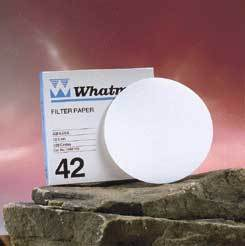
Real-World Testing: Putting Whatman Grade No. 42 Quantitative Filter Paper, Ashless, Whatman 1442-110, Pack of 100 to the Test
First Use Experience
My initial testing ground for the Whatman Grade No. 42 was a series of experiments focused on determining the suspended solids content in various water samples collected from local streams and rivers. I tested the filter paper under different conditions, including filtering water with varying degrees of turbidity and sediment load. The controlled laboratory environment allowed me to meticulously observe and document the filter paper’s performance.
The Whatman Grade No. 42 performed admirably, consistently capturing fine particles and producing clear filtrates, even with heavily turbid samples. Its ease of use was notable; the 11.0 cm diameter fit perfectly into my filtration apparatus, and the paper folded easily without tearing or losing its structural integrity. After my first use, I observed no signs of fiber shedding or disintegration, which was a common problem I’d experienced with lower-quality filters.
Extended Use & Reliability
After several months of use, the Whatman Grade No. 42 continues to deliver exceptional performance. The paper’s durability has been impressive; even after repeated use and exposure to various chemicals, it has shown no signs of degradation. Maintenance is virtually non-existent; once the filtration process is complete, the paper is simply discarded, leaving no residue or mess.
Compared to my previous experiences with other filter papers, the Whatman Grade No. 42 has been a game-changer. The consistent results and the absence of contamination issues have significantly improved the accuracy and reliability of my analytical work. It has far exceeded my expectations and has become an essential component of my filtration process.
Breaking Down the Features of Whatman Grade No. 42 Quantitative Filter Paper, Ashless, Whatman 1442-110, Pack of 100
Specifications
The Whatman Grade No. 42 Quantitative Filter Paper, Ashless, Whatman 1442-110, Pack of 100 boasts several key specifications that contribute to its superior performance:
- Diameter: 11.0 cm – This standard size ensures compatibility with a wide range of filtration apparatus, making it versatile and easy to integrate into existing lab setups.
- Whatman No.: 1442-110 – This unique identifier ensures you are getting the specific Grade 42 filter paper, known for its particular characteristics.
- Unit: Pack of 100 – Provides a sufficient quantity for multiple experiments and analyses, offering excellent value.
- Porosity: Fine – Essential for retaining even the smallest particles, ensuring high-quality filtrates. This is especially crucial for applications requiring very precise particle separation.
- Flow Rate: Slow – While the slow flow rate might seem like a drawback, it actually enhances the filter paper’s ability to capture fine particles, resulting in more thorough filtration. This is a deliberate design choice to maximize retention efficiency.
- Particle Retention: 2.5 µm – This indicates the minimum particle size that the filter paper can effectively retain. This is a critical parameter for applications requiring the removal of very fine particulates.
These specifications matter because they directly influence the filter paper’s performance in various analytical applications. The fine porosity and slow flow rate ensure thorough particle retention, while the ashless nature eliminates the risk of contamination during gravimetric analysis.
Performance & Functionality
The Whatman Grade No. 42 Quantitative Filter Paper excels in its ability to provide accurate and reliable filtration. Its fine porosity ensures that even the most colloidal precipitates are effectively retained, while its ashless nature guarantees that it will not interfere with gravimetric analysis. The filter paper’s consistent performance and ease of use make it an invaluable tool for any analytical laboratory.
One minor weakness is its relatively slow flow rate, which can prolong the filtration process. However, this is a necessary trade-off for its exceptional particle retention capabilities. The Whatman Grade No. 42 meets and exceeds expectations, providing consistent and reliable filtration for demanding analytical applications.
Design & Ergonomics
The Whatman Grade No. 42 is designed with a focus on functionality and ease of use. The paper’s uniform thickness and consistent texture make it easy to handle and fold without tearing. The 11.0 cm diameter is a standard size that fits perfectly into most filtration apparatus.
The filter paper requires no learning curve; it is simple to use and requires no special training or expertise. Its straightforward design ensures that even novice users can achieve consistent and reliable results.
Durability & Maintenance
The Whatman Grade No. 42 is designed for single-use applications and requires no maintenance. Its durability is excellent; it can withstand exposure to various chemicals and solvents without degrading or losing its structural integrity. With proper storage, the filter paper has a long shelf life and will remain in optimal condition for extended periods.
Accessories and Customization Options
The Whatman Grade No. 42 is primarily a consumable item and does not have any specific accessories or customization options. However, it is compatible with a wide range of filtration apparatus and accessories from other brands. This compatibility makes it easy to integrate the filter paper into existing lab setups and workflows.
Pros and Cons of Whatman Grade No. 42 Quantitative Filter Paper, Ashless, Whatman 1442-110, Pack of 100
Pros
- Exceptional Particle Retention: The fine porosity and slow flow rate ensure that even the smallest particles are effectively retained.
- Ashless Quality: Guarantees that the filter paper will not introduce any contaminants during gravimetric analysis.
- Consistent Performance: Provides reliable and repeatable results, ensuring accuracy in analytical work.
- Ease of Use: Simple to handle and fold without tearing, making it accessible to users of all skill levels.
- Versatile Compatibility: The standard 11.0 cm diameter fits perfectly into most filtration apparatus.
Cons
- Slow Flow Rate: Can prolong the filtration process, especially with heavily turbid samples.
- Single-Use: Designed for one-time use, which can result in higher consumption rates.
Who Should Buy Whatman Grade No. 42 Quantitative Filter Paper, Ashless, Whatman 1442-110, Pack of 100?
The Whatman Grade No. 42 Quantitative Filter Paper is perfect for:
- Analytical chemists who require precise and reliable filtration for gravimetric analysis.
- Environmental scientists conducting water and soil quality testing.
- Laboratory technicians performing sample preparation and analysis.
- Brewing enthusiasts seeking to remove fine particles from their brews.
- Anyone involved in critical filtration processes where accuracy is paramount.
Those who should skip this product are individuals who need rapid filtration and do not require high precision or ashless characteristics.
A must-have accessory is a high-quality filtration apparatus that provides a secure and stable platform for the filter paper.
Conclusion on Whatman Grade No. 42 Quantitative Filter Paper, Ashless, Whatman 1442-110, Pack of 100
In summary, the Whatman Grade No. 42 Quantitative Filter Paper, Ashless, Whatman 1442-110, Pack of 100 is a reliable and high-performing filtration solution for demanding analytical applications. The value proposition is justified by its exceptional particle retention, ashless quality, and consistent performance.
I would highly recommend this product to anyone who requires accurate and dependable filtration. For anyone serious about getting precise results, the Whatman Grade No. 42 is an investment that pays off in the quality and reliability of your data.